Reddit Lead Generation, Step by Step: The System We Actually Run
This is the Reddit lead generation system we run for RankCow itself, written down the way we would hand it to a new hire: the subreddits we watch, the rubric we use to decide whether a post is worth a reply, the reply and DM templates we send, and the sheet we track it all in. If you want the beginner version, with the 90-9-1 rule and the account warm-up, that lives in our Reddit marketing strategy post and we will not repeat it here!
One definition so we are talking about the same thing. Reddit lead generation means finding posts where someone describes a problem your product solves, or asks for a recommendation, and turning that thread into a conversation you can follow up on. Everything below is how we do that in practice, including the parts that did not work.

The subreddits we actually watch
We monitor ten communities for RankCow. Five are worth naming because the reasoning behind each one transfers to any product:
r/startups is where founders post "how do I get my first users" threads. Broad, but the intent is real and the moderators tolerate honest replies from people who build things.
r/askmarketing is nearly all questions. A community where every thread is someone asking for help is the closest thing to a lead feed Reddit has.
r/Entrepreneur is huge and noisy. We keep it because the volume means a few strong posts every day even after our filter throws most of it away.
r/EntrepreneurRideAlong has a smaller, more candid crowd. People describe what they tried and what failed, which makes scoring easy.
r/growthhacking is where people already believe in the channel and are comparing tools by name.
The rule we use when adding a community: read the newest fifty posts, count how many are someone asking for help with a problem we solve, and only keep it if that number is above five. A community like r/marketing tends to fail that test. It is one of the biggest marketing communities on the site, but most posts are industry news and career questions, and the few that are leads get buried inside an hour.
We also cap ourselves at ten communities. Every extra subreddit adds posts to score and replies to write, and the replies are the part that has to stay good.
Why we do not use keyword alerts to find leads
The obvious version of this runs on keyword alerts: "looking for," "alternative to," "any recommendations" and a list of competitor names. We decided against it early, because it misses most of the good posts. The best leads rarely use those phrases. They write three paragraphs about launching a product to silence and end with "any tips?" No keyword catches that.
So we changed the approach. Every new post in a monitored subreddit gets read and scored on its own, with no keyword pre-filter. That is more expensive per post but it is the only way we found to catch the three-paragraph "any tips?" lead. If you are doing this by hand and need alerts anyway, our Reddit keyword alerts guide covers the least-bad way to set them up.
The scoring rubric we use before anyone replies
This is the heart of the system. A post gets a tier, a set of signals, and a fit score from 0 to 100. We only spend time on a post once it has all three.
Tier | What it looks like | What we do |
|---|---|---|
Problem aware | Describes a pain our product removes, has not asked for a tool. "Our launch got zero traffic and I don't know where our users hang out." | Reply only if fit is above 40. Never mention the product. |
Solution seeking | Asks an open question whose normal answers include our category. "How are you finding customers on Reddit without getting banned?" | Reply with a full answer. Product mention only if it is genuinely the answer, with disclosure. |
Comparing | Names tools, asks which one. "GummySearch vs F5Bot for finding leads, which is worth it?" | Reply with an honest comparison including where we lose. DM if they respond. |
Purchase ready | Budget, deadline, or a decision this week. "Have $100/mo, need something running before our launch on the 15th." | Reply within the hour and DM the same day. |
The five signals we mark on every post are: asked for a recommendation, named the tool they use today, said they are thinking of switching, stated a budget, and stated a deadline. In one batch of 60 leads we scored, 50 asked for a recommendation, 24 named their current tool, 9 were considering a switch, 9 mentioned a budget, and exactly one had a deadline. That distribution is why we weight "named their current tool" so heavily: it is common enough to act on and it tells you what to compare against.
Two rules that took us a while to learn:
Dissatisfaction is a lead. Someone complaining about a tool they currently pay for is hotter than someone asking a general question. They have budget, they have a use case, and they are already unhappy. We score those as comparing even if they never ask for an alternative.
Some posts are never leads no matter how relevant they sound. Launch posts and "roast my app" threads, hiring and co-founder requests, hot-take debate bait, "here is how I hit $10k MRR" recaps, and anything that is itself a promotion. The looser version of our rubric let these through, and none of them are worth a reply.
When we tightened this rubric in July, it threw out 62 percent of what the looser version had called a lead. The feed got much shorter, and everything left in it was a post worth a real reply. Fewer, better posts is the whole point.
The reply, then DM, sequence
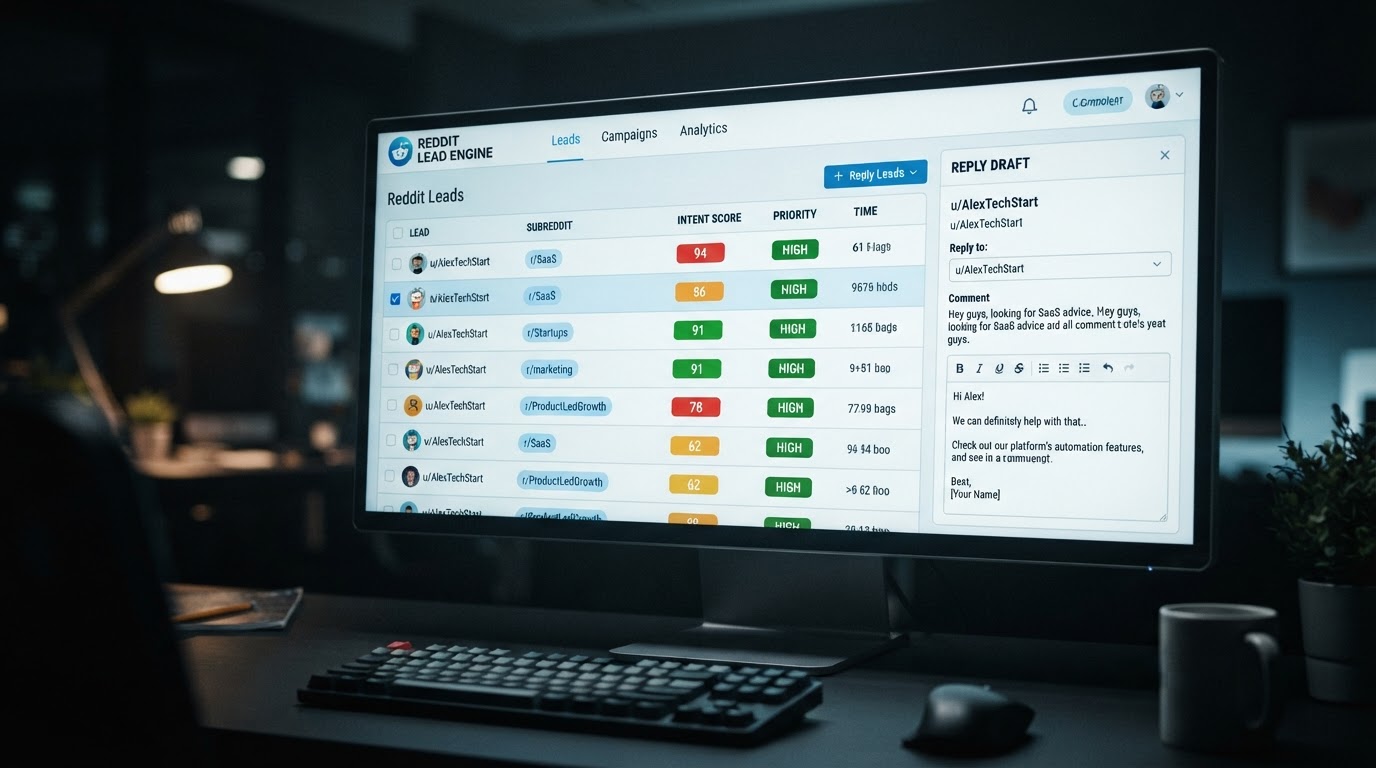
We always reply in public first. A DM with no public reply behind it reads as a cold pitch and Reddit's own spam filters treat it that way. The public reply earns the DM.
Template 1: the public reply
Three parts, in this order: answer the actual question, name a trade-off, disclose. Here is a real shape of reply we send to a solution-seeking post about finding customers on Reddit:
The thing that worked for us was picking 5 subs where people describe the exact problem and just answering questions there for a few weeks before ever mentioning what we built. The trade-off is it's slow. You won't see anything for the first 3 or 4 weeks and most people quit before then.
Full disclosure, I work on a tool that does the monitoring part of this, but honestly the manual version works fine at your stage. Happy to share our subreddit list if useful.
Notice what is not in there: no link, no feature list, no "check out." The offer at the end ("happy to share") is the hook. People who want it ask, and now they have invited the conversation.
Template 2: the first DM
Sent only after the person replies to our comment, upvotes it, or asks for the thing we offered. Never before. Short, references their post, gives them the thing before asking anything.
Hey, saw your reply on the r/startups thread. Here's the list I mentioned: [five subreddits with one line on why each]. If you tell me what you're building I can tell you which two I'd start with.
That last sentence is the only ask, and it is an ask for information, not a sale. The mechanics of sending this, including the difference between chat and the older private message system, are in our guide to how to DM someone on Reddit.
Template 3: the one follow-up
If there is no reply after three days, we send one more message and then stop forever.
No worries if you're heads down. One thing I forgot to mention: [one specific, useful idea tied to their post]. Good luck with the launch.
One follow-up, not three. A second unanswered DM to someone who never asked for it is the fastest way we know to get reported, and reports are how accounts get throttled.
Timing
Our sweep runs every two hours, so the oldest a post can be when we see it is about two hours. That matters because the replies that end up at the top of a thread are almost always posted in the first few hours. If you are checking manually, the best time to post on Reddit data applies to replies too: catch the thread while it is climbing.
The tracking sheet
It is easy to track nothing and then have no idea which subreddit is producing customers. Every lead we reply to gets a row. These are the columns, and the two we look at most are the last two.
Column | Why it is there |
|---|---|
Date, subreddit, post link | So we can go back and read the thread when reviewing. |
Tier and signals | To check whether our scoring predicts outcomes. It mostly does. |
Reply upvotes at 24 hours | A reply under 2 upvotes at 24 hours is usually invisible. We rewrite the template if a subreddit keeps producing those. |
DM sent, DM replied | The reply-to-DM step is where most leads die. Watching it per subreddit tells us where our public replies are landing. |
Outcome | One of: no reply, conversation, signed up, paying. Nothing else. |
Conversations per subreddit | Reviewed every Friday. A subreddit with 30 replies and zero conversations gets swapped out. |
The Friday review is the part that makes this a system rather than a habit. It takes about fifteen minutes, and it is where the subreddit list and the templates get changed.
What it costs, in our numbers
Money first, because it is simpler. We post from our own account through the RankCow Chrome extension, which costs no credits. The $99 a month plan comes with 100 credits per billing cycle. A comment posted through one of RankCow's partner accounts instead of your own costs 10 credits, so that is about ten posted comments a month if you never use your own account. Drafting a reply or a DM costs 0.1 credit, which in practice means drafting is free and posting is the thing you ration. If you want to run this with no tool at all, the whole system above works with a spreadsheet and Reddit's new-post feed. It just takes more of your day.
Time is mostly spent writing. Once the sweep and the scoring run on their own, finding posts is close to zero effort and almost all of the work is the reply, the DM, and the Friday review. Reddit lead generation free of any tooling is possible, and it is how we started, but the hours go into refreshing feeds instead of into replies, and replies are the only part that produces customers.
The other cost is the account. We learned this the hard way: our own account went from a couple of comment throttles to a shadowban within a single day in July. The new Reddit interface showed it as a full ban, which it was not. We found the real status the old-fashioned way, checking the profile from a logged-out browser. We deleted every comment that mentioned the product, filed an appeal, and stopped posting from that account. If you think this has happened to you, our Reddit shadowban check walks through the same test. The lesson that changed our system: the reply template above has no link in it, and that is not a stylistic choice.
Tools, briefly
We keep this to one paragraph because we have a full comparison elsewhere. The monitoring and scoring in this post is what RankCow does, and the reason we built it was the keyword-alert problem described above. If you are deciding between a listening tool and something that also handles replies, our GummySearch alternative comparison covers that specific decision, and the best Reddit marketing tools roundup ranks everything we have tested, including the free options.
Frequently Asked Questions
How do I find leads on Reddit?
Pick a small number of subreddits where people describe the problem you solve, read every new post rather than filtering by keyword, and score each one by whether the author asked for a recommendation, named a current tool, mentioned switching, stated a budget, or stated a deadline. Reply in public to the ones that score well, and only DM people who respond to your reply. That is the entire system in one paragraph. The rest of this post is the detail.
Is Reddit good for lead generation?
For products people ask strangers about, yes, and it is unusually good for B2B because people post the problem rather than their job title. It is a poor fit if your buyers never discuss the problem publicly, or if your sales cycle needs a phone call before anyone will engage. The honest test is to read fifty new posts in your best candidate subreddit and count the leads. Under five means the channel is probably not worth building a system around.
Can you do Reddit lead generation for free?
Yes. Everything in this post can be run with a spreadsheet, the subreddit new-post feed, and your own account. Posting from your own account through the RankCow extension is free too. What you pay for with any tool is the reading and scoring of posts, which is the part that eats the most time when done by hand.
What should a Reddit lead generation tool actually do?
Three things, in order of importance: read every new post in your subreddits and tell you which ones are leads and why, help you write a reply that sounds like you and not like an ad, and keep your account safe while doing it. Alerting on keywords is not on that list because keywords miss the best posts. Anything beyond those three is nice to have.
How long before Reddit leads turn into customers?
Weeks, not days. The public reply has to land, the person has to respond, the DM has to be useful, and they have to have a reason to try something. Plan for a month of replies before judging it, and use the tracking sheet so the judgement is based on conversations per subreddit rather than on how it feels.
If you would rather not read every post in ten subreddits yourself, RankCow runs the sweep, the scoring rubric, and the reply drafting described in this post, and you post from your own account through the extension. The templates and the tracking sheet still apply. They are the part no tool does for you.