How to Increase Google Rankings: A Step-by-Step Guide for 2026
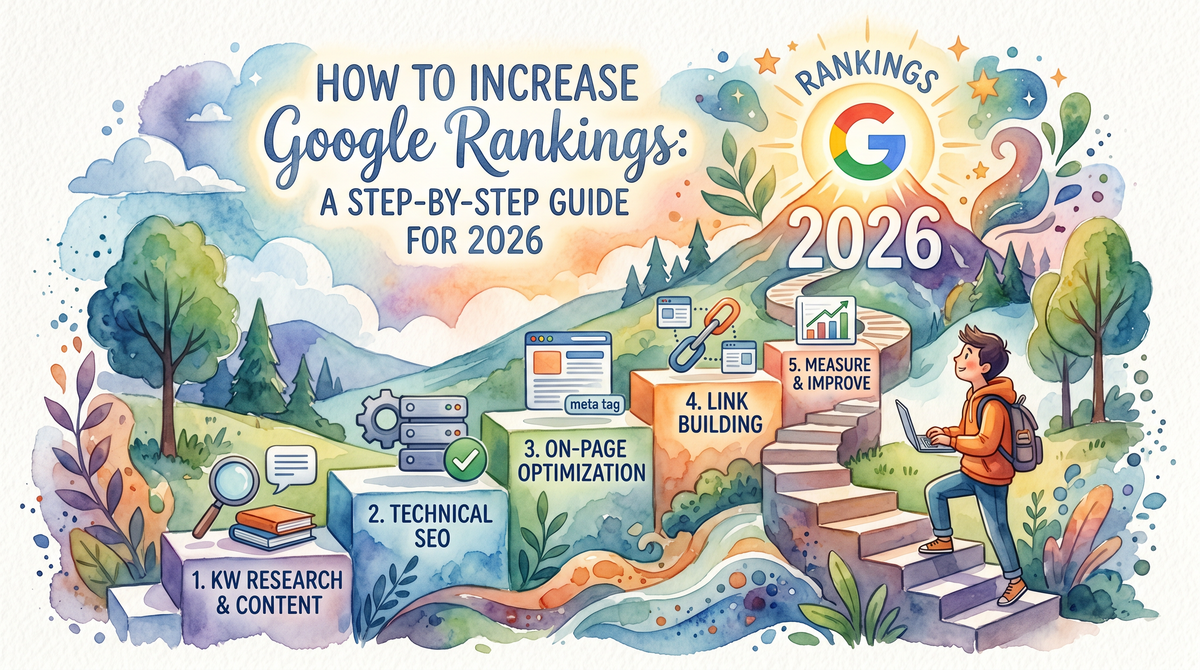
To increase Google rankings, you need to consistently publish high-quality, intent-matched content, build topical authority through internal linking, earn relevant backlinks, and keep your technical foundations clean. There is no single lever. Google's algorithm weighs five core signal groups: domain authority, topical authority, document quality, freshness, and user engagement, and the sites that win are the ones addressing all five, not just one. The top 3 organic search results receive more than two-thirds (68.7%) of all clicks on the Google Search page, which means ranking improvements have a direct, compounding impact on your traffic and leads.
Let's be honest: most people who struggle with rankings are not doing one thing catastrophically wrong. They're doing a dozen small things inconsistently. This guide fixes that.

Why Google Rankings Matter More Than Ever in 2026
Here's the thing: the competition for page one is not getting easier. Google AI Overviews now appear on 48% of all queries as of April 2026, up from 31% in early 2025, and pages cited inside AI Overviews earn 35% more organic clicks than non-cited competitors. That is a structural shift. Being on page two is effectively invisible.
Understanding how SEO fits into your broader digital marketing strategy is the first step most people skip. They jump straight to tactics without understanding the system. Don't do that.
"Ranking is no longer driven by keyword manipulation or mass backlink accumulation. Visibility depends on whether a page provides clear, trustworthy answers that satisfy real user needs." — Industry consensus, 2026
What Google Actually Measures in 2026
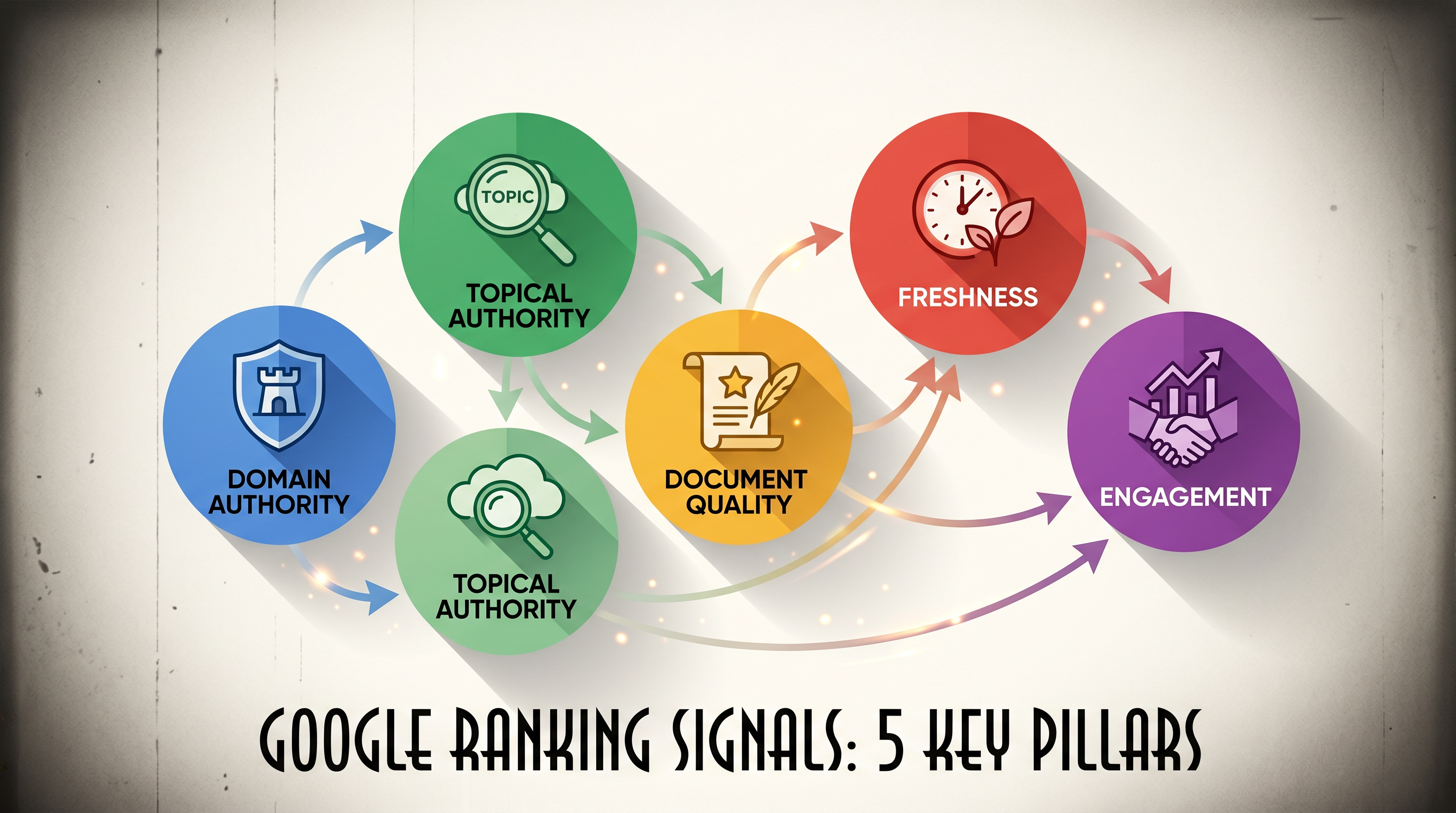
The most important Google ranking factors in 2026 fall into five buckets: domain authority, topical authority, document quality, freshness, and engagement. That framing is grounded in the May 2024 Google Content Warehouse API leak, which exposed more than 14,000 internal attributes. Here is how those buckets translate into things you can actually control:
| Signal Bucket | What Google Looks At | Your Main Lever |
|---|---|---|
| Domain Authority | Site-wide link popularity (siteAuthority) | Earn quality backlinks consistently |
| Topical Authority | Depth and breadth of content on a subject | Publish clusters of related content |
| Document Quality | E-E-A-T signals, content effort score | Write expert, first-hand content |
| Freshness | Publication date, update frequency | Publish and update regularly |
| Engagement | Click-through rate, dwell time, return visits | Optimize titles, UX, and content depth |
The 8-Step Process to Increase Google Rankings
What I wish someone had told me earlier: SEO results are slow, but the compounding effect is real. This takes longer than you'd expect — typically 3 to 6 months before meaningful movement. The mistake I see constantly is people executing steps 1 and 2, seeing nothing happen in week three, and stopping. Don't stop.
Step 1: Fix Your Keyword Strategy First
Most sites target keywords that are either too broad (impossible to win) or too narrow (no search volume). The goal is high-intent, low-competition keywords where your site has a realistic shot. A solid keyword analysis process starts with understanding search intent, not just search volume. Map every keyword to one of four intent types: informational, navigational, commercial, or transactional, and match your content format to what top-ranking pages are actually serving.
- Use Google Search Console to find keywords where you rank positions 8–20 (low-hanging fruit for movement)
- Target long-tail variations with 3 or more words — keywords between 10 and 15 words in length get 1.76x more clicks than single-word terms
- Check SERP features (AI Overviews, featured snippets) before committing to a keyword
Step 2: Build Topical Authority, Not Just Individual Pages
Google increasingly rewards sites that dominate a subject area rather than publishing scattered, unrelated content. Topical authority now outweighs individual page quality in competitive SERPs. This means publishing interconnected clusters of content on a single subject: a pillar page supported by a series of tightly related articles, all internally linked together.
If you run a SaaS company, building a comprehensive SaaS SEO strategy means owning a full cluster of topics relevant to your product, not just one well-written landing page. Sites that demonstrate topical specialization consistently outrank generalist sites, even when the generalist site has more domain authority overall.
Step 3: Optimize Every Page for E-E-A-T
E-E-A-T (Experience, Expertise, Authoritativeness, Trustworthiness) is Google's primary content quality framework and the single strongest on-page Google ranking factor in 2026. Here's the real talk: Google can now detect this algorithmically, not just through human quality raters. Practical signals that help:
- Include author bios with real credentials
- Cite primary sources and original research
- Add first-hand observations or tested results (not paraphrased summaries)
- Keep content updated with clear "last reviewed" dates
- Build an About page and Contact page that establish your entity clearly
Step 4: Nail On-Page SEO Fundamentals
On-page SEO is not glamorous, but it is where most of the controllable, fast-moving gains live. Focus on:
- Title tags: Title tags between 40 and 60 characters have the highest CTR, with a 33.3% higher CTR compared to those outside that range
- URL structure: Keep URLs short, keyword-relevant, and readable
- Header hierarchy: Use one H1 per page, and structure H2/H3 headings around semantic variations of your target keyword
- Internal linking: Connect related pages to pass authority and signal topical depth
- Schema markup: Structured data helps Google understand your content and improves your chance of appearing in featured snippets
Step 5: Publish Content That Actually Satisfies Intent
Here's what I wish someone had told me three years ago: Google does not just rank the page with the best keywords. It ranks the page that best satisfies what the searcher needed in that moment. The average first-page result contains approximately 1,447 words, while pages that load in under 2.5 seconds rank significantly better. Length matters less than completeness. Ask: does my page fully answer the question, or does the reader have to go back to Google to find the rest?
Content that works in 2026 is structured, scannable, and specific. Use tables, numbered lists, and clear definitions. These formats improve both reader satisfaction and your chance of being cited in AI Overviews, which is now a meaningful traffic lever.

Step 6: Earn Quality Backlinks (Not Just Any Links)
Backlinks are judged less by sheer volume and more by trustworthiness, contextual alignment, and relevance to real users. Links that exist within meaningful content from sources with clear topical authority carry more weight than large numbers of disconnected references. The strategies that work consistently:
- Create original data, studies, or tools that journalists and bloggers cite naturally
- Write genuinely useful guest posts on sites your audience actually reads
- Reclaim unlinked brand mentions (find them in Google Search Console or alerts)
- Build relationships with other publishers in your niche over time
Step 7: Fix Technical SEO Issues That Block Rankings
Technical problems are often invisible but devastating. Before any content investment pays off, Google needs to be able to find, crawl, and index your pages without friction. Core technical audit items:
- Run a crawl audit (Screaming Frog is free for up to 500 URLs)
- Check Core Web Vitals in Google Search Console (aim for "Good" across all three metrics)
- Ensure your site is mobile-first: Google uses the mobile version of your page for indexing
- Fix broken internal links and redirect chains
- Submit an updated XML sitemap to Google Search Console
- Confirm HTTPS is configured correctly sitewide
When evaluating which tools handle these audits efficiently, checking a comparison of the best SEO tools available can help you choose between automated platforms and manual workflows based on your site size and budget.
Step 8: Publish Consistently (This Is Where Most People Fail)
The real talk is that Google's freshness signals reward sites that publish and update regularly. One great article per quarter will not build topical authority. The sites that dominate SERPs in 2026 are publishing multiple times per month, in a structured cluster format. This is exactly the gap that automated content pipelines are built to close: platforms like Rankcow publish 30 SEO-optimized articles per month on autopilot, freeing you from the grind of manual content production while keeping your publishing cadence consistent and Google-compliant.
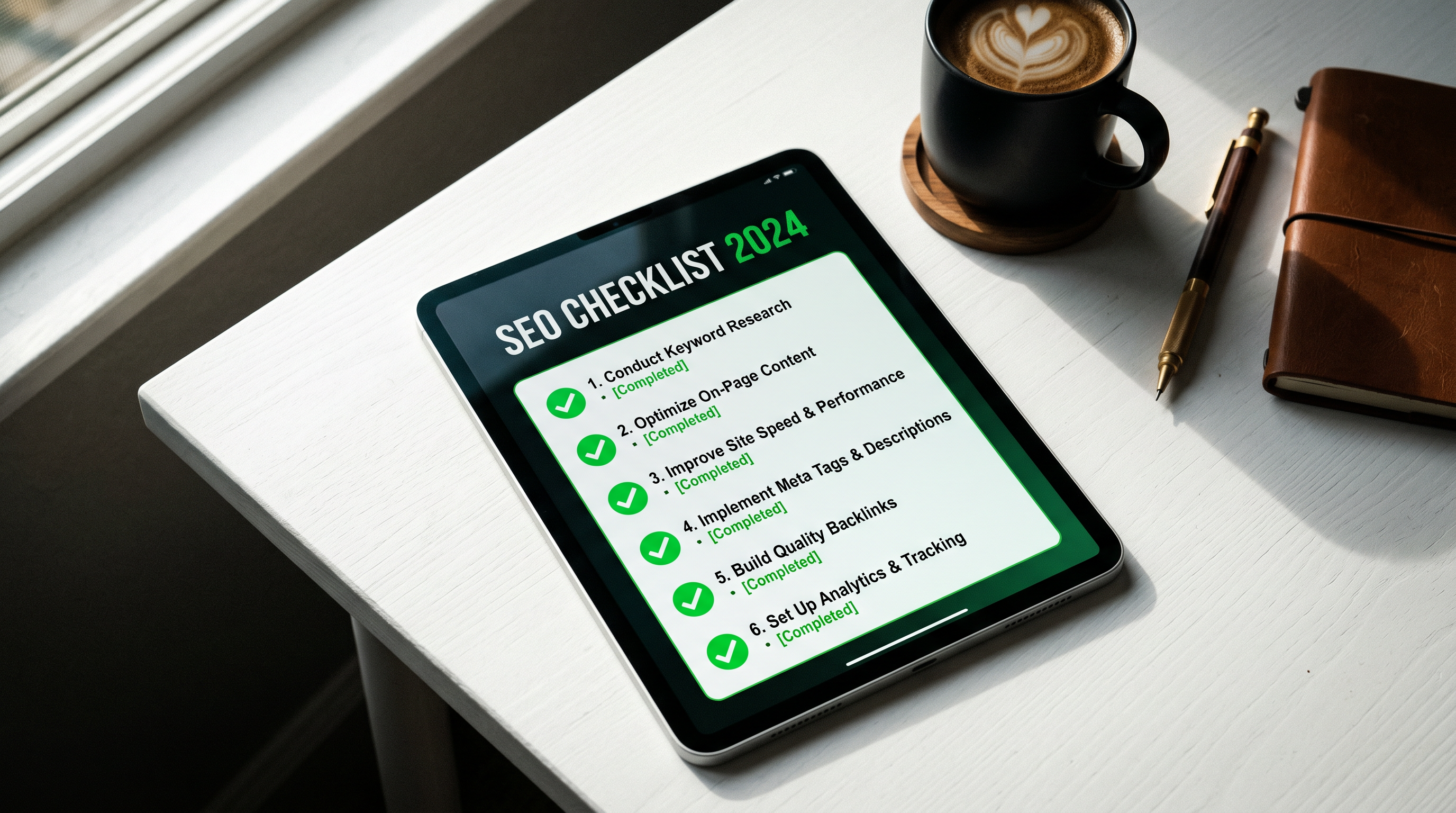
Quick-Reference Checklist (Bookmark This)
- ✅ Identify 10–20 high-intent, low-competition keywords using keyword gap analysis
- ✅ Map each keyword to a clear search intent (informational, commercial, etc.)
- ✅ Plan a topic cluster: one pillar page + 5–8 supporting articles per main subject
- ✅ Optimize every title tag to 40–60 characters with the primary keyword near the front
- ✅ Add author credentials, citations, and first-hand insights to every piece (E-E-A-T)
- ✅ Include schema markup on key page types (articles, FAQs, products)
- ✅ Run a technical crawl audit and fix Core Web Vitals issues
- ✅ Build at least 2–4 contextually relevant backlinks per month
- ✅ Publish new content on a consistent schedule (weekly minimum for authority building)
- ✅ Review Google Search Console monthly for CTR drops, crawl errors, and keyword opportunities
Common Pitfalls to Avoid
- Publishing thin content at volume: Google's Helpful Content System runs as a sitewide signal. Low-quality pages suppress your well-optimized pages too.
- Ignoring internal linking: Most sites underinvest in this. Every new article should link to at least two related pages and receive links from two existing pages.
- Chasing domain authority alone: A single high-DA backlink from an irrelevant site moves the needle far less than three contextually aligned links from niche publishers.
- Only optimizing for traditional search: AI Overviews now appear on nearly half of all queries. Structure your content to be cited (direct answers, numbered steps, clear definitions).
- Not updating old content: A 2021 article that still ranks can be boosted significantly by a fresh update, new data, and a revised publish date.
Frequently Asked Questions
How long does it take to increase Google rankings?
Realistically, expect 3 to 6 months to see meaningful movement for new content on a relatively fresh domain, and 1 to 3 months for established sites targeting lower-competition keywords. Technical fixes (like Core Web Vitals improvements) can show faster results, sometimes within a few weeks of Google recrawling your pages. The mistake most people make is abandoning a strategy at month two because they don't see results yet. SEO compounds over time, and the sites that win are the ones that stay consistent.
What is the single most important factor for Google rankings in 2026?
There is no single factor, and that framing is actually the trap. The sites outranking you are not winning on backlinks or content alone. They're winning because they score well across multiple signal buckets simultaneously. If you forced a ranking, content quality aligned to E-E-A-T is the baseline without which everything else (backlinks, technical SEO, internal links) underperforms. But topical authority, which is the breadth and depth of your content on a subject, is increasingly the differentiator in competitive niches.
Should I use AI to write SEO content?
AI-generated content is not penalized by Google when it is genuinely helpful and meets E-E-A-T standards. What Google penalizes is low-quality, mass-produced content that fails to satisfy searcher intent, regardless of how it was produced. The practical answer: AI works best as part of a structured pipeline where keyword research, content strategy, internal linking, and brand tone are built in. Tools built around AI writing specifically designed for SEO outperform general-purpose writing assistants because they're built around search intent and optimization, not just text generation.
Do backlinks still matter in 2026?
Yes, but the way they matter has changed. Backlinks remain a major Google ranking factor in 2026, and the leaked siteAuthority attribute confirms Google scores site-wide link authority. Quality and topical relevance now outweigh raw count. Ten relevant, editorially earned backlinks from niche publishers will outperform one hundred irrelevant directory links every time.
Can I increase Google rankings without a big budget?
Yes. The highest-leverage, lowest-cost activities are consistent content publishing, internal linking, and Google Search Console optimization (fixing existing pages that rank positions 5–15). These require time, not money. The budget question becomes relevant when you want to scale: hiring writers, running link campaigns, or using automated SEO platforms to maintain publishing consistency without proportionally increasing headcount. For smaller teams, exploring free AI SEO tools is a smart starting point before committing to paid platforms.
Rankcow takes the manual work out of ranking on Google by automating your entire content pipeline: from keyword research and article writing to publishing and internal linking, all done in your brand's voice across 150+ languages. If publishing consistently is where your SEO strategy breaks down, Rankcow's autopilot platform delivers 30 optimized articles per month at a flat subscription rate, giving you the topical authority and freshness signals Google rewards without the agency overhead. Start your free trial at Rankcow.com and see why 1,000+ sites trust it to drive organic growth on autopilot.